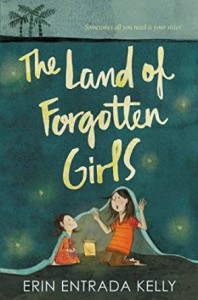
Summary: The Land of Forgotten Girls written by Erin Entrada Kelly is centered on two young Filipino girls who have relocated to Louisiana from the Philippines with their father and step-mother after their mother and sisters' unfortunate deaths. After their dad abandons both Soledad Madrid and her younger sister Ming, they struggle to come to terms with their new lives in the United States with only their evil step-mother to rely on. Just as Sol becomes hardened as a result of their misfortunes, Ming starts to become imaginative and begins to think that their mythical Aunt Jove (who supposedly travels the world and rides elephants) will rescue them from their current situation. Sol struggles to maintain a healthy balance between being imaginative for the sake of her sister and being true to herself and her realistic mentality. Sol cares deeply for her sister and only wants the best for her, but how can she protect Ming from her own imagination?
Target Audience: The target audience for this book seems to be late elementary students to middle schoolers, possibly between 5th-6th grade. I feel as though children from the ages of 10-12 would enjoy the whimsical nature of this book and how it is balanced out by the real life events that take place. I also think that readers would enjoy the adventures Sol and her friends Manny and Caroline have throughout the book.
Evaluation Based on Donna Norton's Text: In terms of representation, this book has a lot of diversity and depicts various different people of different races and ethnicities such as Filipino, Asian, Mexican, etc. In addition, the book also includes a young Albino girl. I would definitely include this book in a classroom library as a good example of representation in literature as it depicts a broad variety of minority groups and it would allow for students of different cultural backgrounds to relate to the book. It is also important to note that this novel did not fall into the typical stereotypes that usually follow minority groups, as their cultures are accurately portrayed and not glorified. A quote that really stuck out to me within Donna Norton's (2007) text, "Through The Eyes of a Child," she states, "Through multicultural literature, children who are members of racial or ethnic minority groups realize that they have a cultural heritage of which they can be proud, and that their culture has made important contributions to the United States and to the world," (p. 78). I feel that this quote perfectly encapsulates why representation matters specifically when it comes to children's literature, which Entrada utilizes within her text flawlessly.
Reader Response Activity: I would have my students analyze the important aspects of imagination that play a huge role in the development of the characters within the novel. Below, I have attached a link to the worksheet that I created.
Link to my Reader Response Activity: https://drive.google.com/file/d/1bFFCmbNRDSDrr-Wz9xzB0QZWiSN_PJcb/view?usp=sharing
APA Citation:
Kelly, E. E. (2016) The Land of Forgotten Girls. HarperCollins.
Genre: Juvenille Fiction.
Link to Information About The Book: https://books.google.com/books/about/The_Land_of_Forgotten_Girls.html?id=zAnVCQAAQBAJ&source=kp_book_description
Readibility Lexile: 640L
Blog Requirements: Early Chapter Book, Written in the last four years, Supports a Diverse Protagonist, Engages middle school readers, Online Material (E-Book).
